Learning Ice
“The ice hammer itself is a key to the world of legends that I’ve dreamed of in my fading boyhood"-Steve House
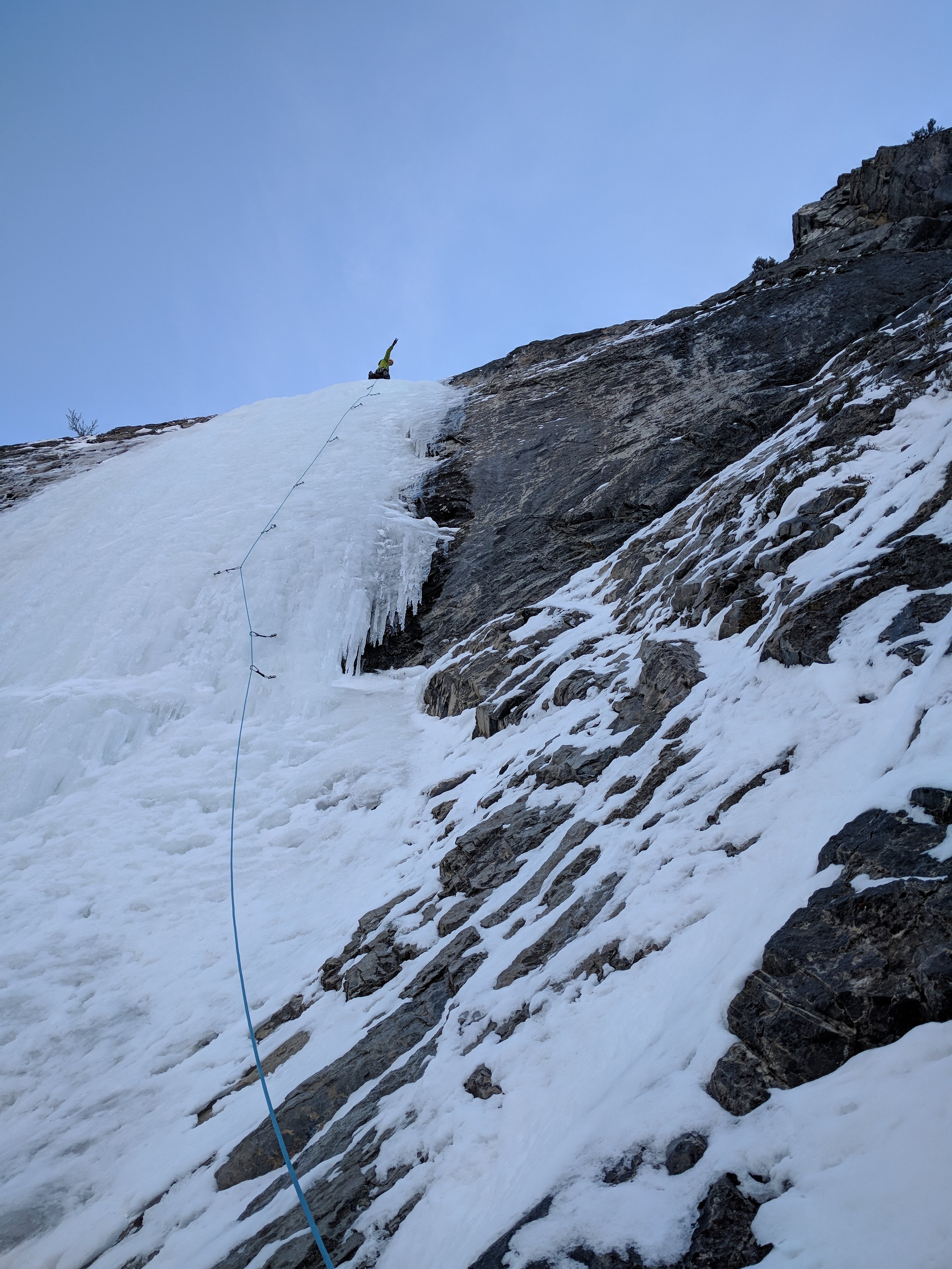
I climbed ice for multiple seasons via top rope in order to get large volume of practice before I ever considered hopping on the sharp end and leading ice. Here I follow an enthusiastic leader up “Back Off” (WI4)-Santaquin Canyon, UT. About 2 weeks later, climbers were knocked off the lower pitches of Squash head due to an avalanche.
The Dead Arm
By Fall of 2016 I was wearing a neck brace unable to turn my head to the side or look up or down. The surgeon said wasn’t allowed to lift more than 20lbs and shouldn’t take larger steps than a stair or the curb. I spent the first week post-surgery, lying propped on a pillow to avoid the strain of trying to sit up from a bed. I couldn’t swallow without extreme pain in my throat, which made eating solid food very unpleasant. If my girlfriend and my Mom hadn’t come to help me get groceries and cook/clean up after myself, I would have had a much harder time. I felt like a worthless slug, just lying around staring at a computer screen watching movies until I passed out multiple time during the day. My aspirations of climbing the steepest mountains seemed impossible at this point.
Part of pushing one’s limits involves reviewing and recalibrating your assessment of risk after experiencing success or failure. It is particularly important when you have a close call to debrief and re-assess your abilities afterward. I assumed I knew where the edge of my abilities was, but my near-miss on Island Peak had made me seriously question the ability to safely and objectively self-evaluate. Apparently, I had crossed the line and it put me closer to death than I cared for. Going back to the drawing board meant that I would need to re-assess the risk of climbing. An enticing alternative to my failed attempt in Nepal was to improve my technical skill and physical strength for more vertical continuous multipitch climbing. Specifically, I had dabbled in ice climbing but had was too cautious to lead climb on ice. Tackling more technically demanding objectives at more forgiving altitudes seemed safer than the near-miss I had in the Himalayas. If I was going to bask in the leisure of oxygen-dense air below 3000 meters then by golly I better be breathing hard because I was climbing steeper terrain.
I was counting down the days until I was allowed to lift my arms above my head and I was growing tired of having everyone carry objects for me. It was a long six weeks and by the time I was cleared to begin physical therapy, I was chomping at the bit. When I went in for an assessment, it was obvious that my serratus anterior muscle was nearly non-functional. It stabilizes the scapula as you lift the arm in an upper cut motion, but in my case, my scapula rotated off of my ribs and stuck out like a chicken wing. Whenever I attempted to lift my arm upward, I would it an invisible ceiling that prevented me from getting my elbow up to face level. It was extremely frustrating. How does one do a pull up or hold an ice axe without being able to lift your dominant hand above your one’s own head?
I did physical therapy every single day for nearly 6 months and it always hurt, but it could never hurt like the nerve pain did. When I first began to boulder in the gym, I struggled to reach far away holds with my right arm, and I was terrified of dropping to the mat with any sort of impact on my freshly repaired spine. Dynamometer readings of grip strength put my right arm at about 20-30lbs weaker than my left. My formerly dominant hand was now my weak arm. I had help from athletes who understood PT well and worked with me to regain functional strength. I did strength training 3 days each week with weights, climbing, and hangboarding mixed in. My arm was getting stronger, but after a year I still couldn’t fully straighten it above my head. The last 2 inches were excruciatingly difficult to achieve and frustrated me to no end. I still couldn’t do a single pull-up.
At this point, I was very worried that my climbing days would be over, or at the very least severely limited. However, I am not typically one to let ambitions die off. My frustrations typically manifest in a form of self-punishment. Strength training became a top priority and each failed attempt to raise my arm meant that I just needed to work harder and so I upped my strength training to five days per week. Having learned from my overtraining debacle in Nepal, I mixed in yoga, saunas, stretching, and varied exercise like biking into the mix. Slowly but surely I reached a point where I could do 1-2 pullups. This was enough of a taste of victory for me to dedicate the extra time for training and rehabilitation.
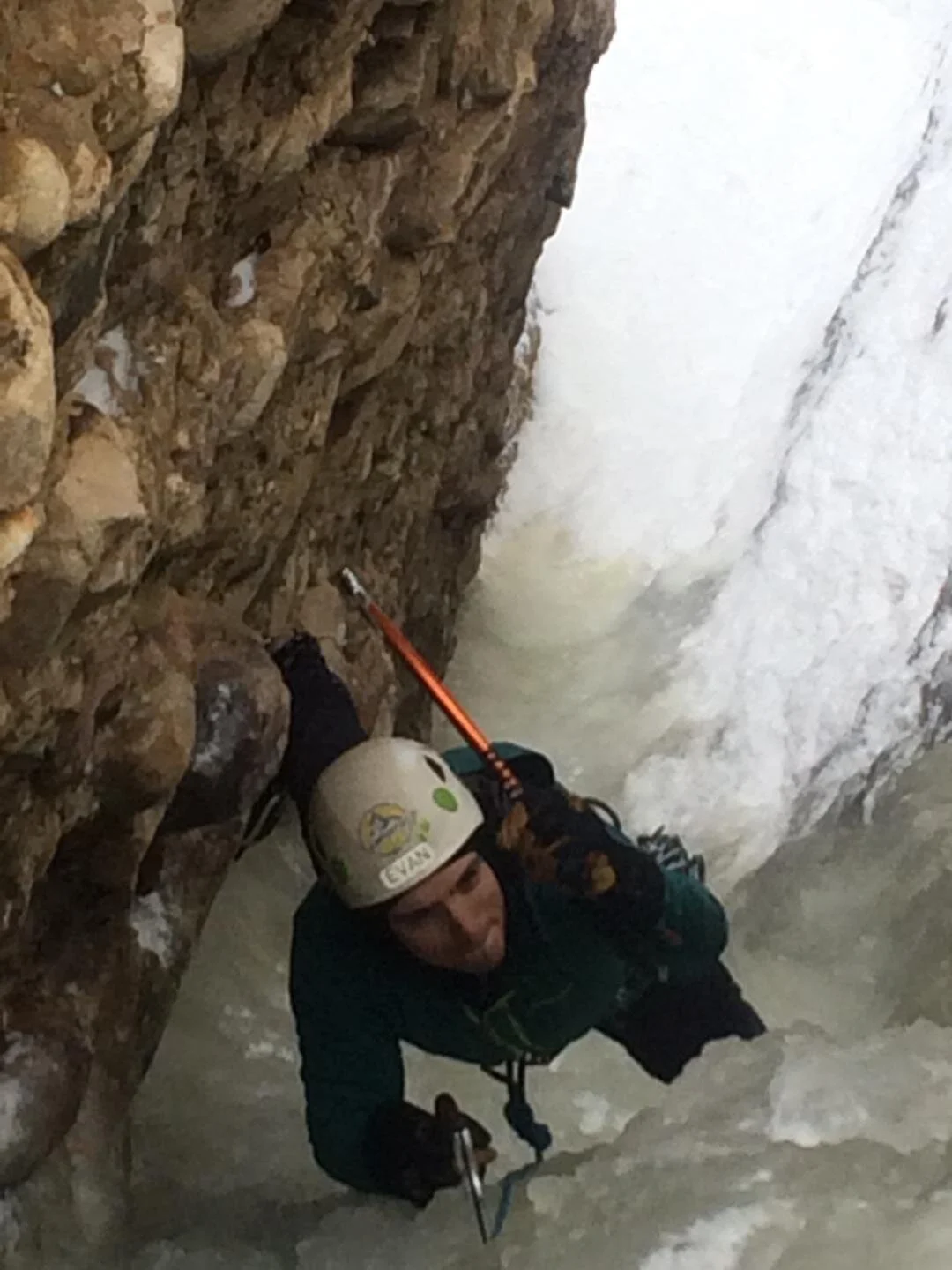
Following yet another pitch of WI4 trying to get a variety of different features and positions to refine my technique.
An ICE, ICe, Baby
By winter of 2017, I was strong enough to climb again but had missed much of the ideal fall season. The danger of high altitude was still fresh in my mind, and so I turned my sights toward ice climbing. I had previously ice climbed in Rocky Mountain National Park and did the same in Provo Canyon by walking to the top of ice falls and setting up top roping anchors and running laps. My only experience leading was on “alpine ice” which was really hardpacked snow and dirt in gullies and couloirs that tended to be fairly low angle terrain to ascend. I had my eyes on vertical water ice, and I wanted to lead climb it but in 2017, global warming combined with seasonally bizarre temperatures meant hardly any ice forming in the Wasatch.
Ice is fickle and difficult to read, even more so than rock and tends to break more easily as well. If it is too cold, the ice gets brittle and the top layer will slide off like broken dinner plates, potentially smashing you in the face. If it is too warm, it melts into a slushy consistency where your ice tools will shred downward leaving claw mark trails like a cat down a curtain. There is a sweet spot in temperatures somewhere between 20-30F where a well-placed swing will stick the pick of your ice tool so firmly that a harmonic wobble will vibrate through the handle of your tool. These well-placed swings are so satisfying that you aim to perfect the whipping of the wrist and the follow through of the tool to it’s final contact. Otherwise, poor swings will bounce off the ice with a twist as the tool flips 90 degrees orthogonally to the ice requiring you to pull back and swing again. The more swings it takes to get the tool to stick, the more tired you become.
Even more challenging and essential was the footwork. Most rock climbers spend a lifetime perfecting foot placement on the rock in order to reduce the load on their fingers and arms. On lower angle slab climbs with tiny features, you are forced to push your heal down and “smear” the ball of your foot across small or non-existent features. On overhanging terrain you often point the very tips of your toes onto tiny crystals or other protuberances. In vertical cracks, you must push your foot into the crevice and then twist it to lock your toes or feet in place. All of these options are not options when you have a thick boot strapped to your foot and are climbing ice which often has less features to edge upon. Instead, you are required to kick into the ice, sinking the bladed toepoints of your crampons securely into the ice. This often maximizes the strain on your calf muscles as you climb upward.
Although I was slowly becoming familiar with many of these eccentricities, none of these aspects were deterrents, they were merely novel techniques that were exciting to learn. The real beast of leading ice is the nature of protecting the leader. Sport climbing involves clipping 32kn bolts that were previously driven into the rock with drills and/or glue which are often strong enough to hold the weight of an elephant. Similarly, trad climbing relies on passive metal protection which consist of industrial cable and aluminum or spring-loaded camming devices often stronger than the rock you are holding onto. I have fallen many times on these types of protection without issue and had also tried (and failed) to rip them out using several burly guys yanking on 4:1 haul systems attached to dynamometers. Rock protection can be incredibly strong and reliable and often only takes seconds to place.
Ice protection on the other hand depends on integrity of frozen water crystals and often takes a minute to place, making the entire process mildly terrifying at times. When you lead ice, you periodically must place ice screws in order to limit your fall potential. An ice screw is a threaded aluminum or steel screw with sharpened teeth on the end and is roughly the thickness of your finger, but with a hollow center. To place one, you must unclip it from your harness and stab it into the ice with a twisting motion until the screw bites into the ice. This is done while you are hanging from your opposite hand on a tool, and your two feet below you. Eventually, the screw will bite into the ice and you can use a twist crank handle to thread it into the ice fully. You can then clip a quickdraw to the screw and by this point, you have been hanging on one arm for a minute or two and your forearm is probably tight and burning with lactic acid. Before you can clip the rope to the screw, you often need to shift back onto your other tool and release your grip to shake blood back into your fingers as they were raised above your head for quite some time. You can try to clip the rope with your opposite hand, and then you may continue climbing upward. In good ice, with proper technique, the entire dance minimizes the strain on your hanging arm and culminates with a well-placed screw to catch you in case you fall.
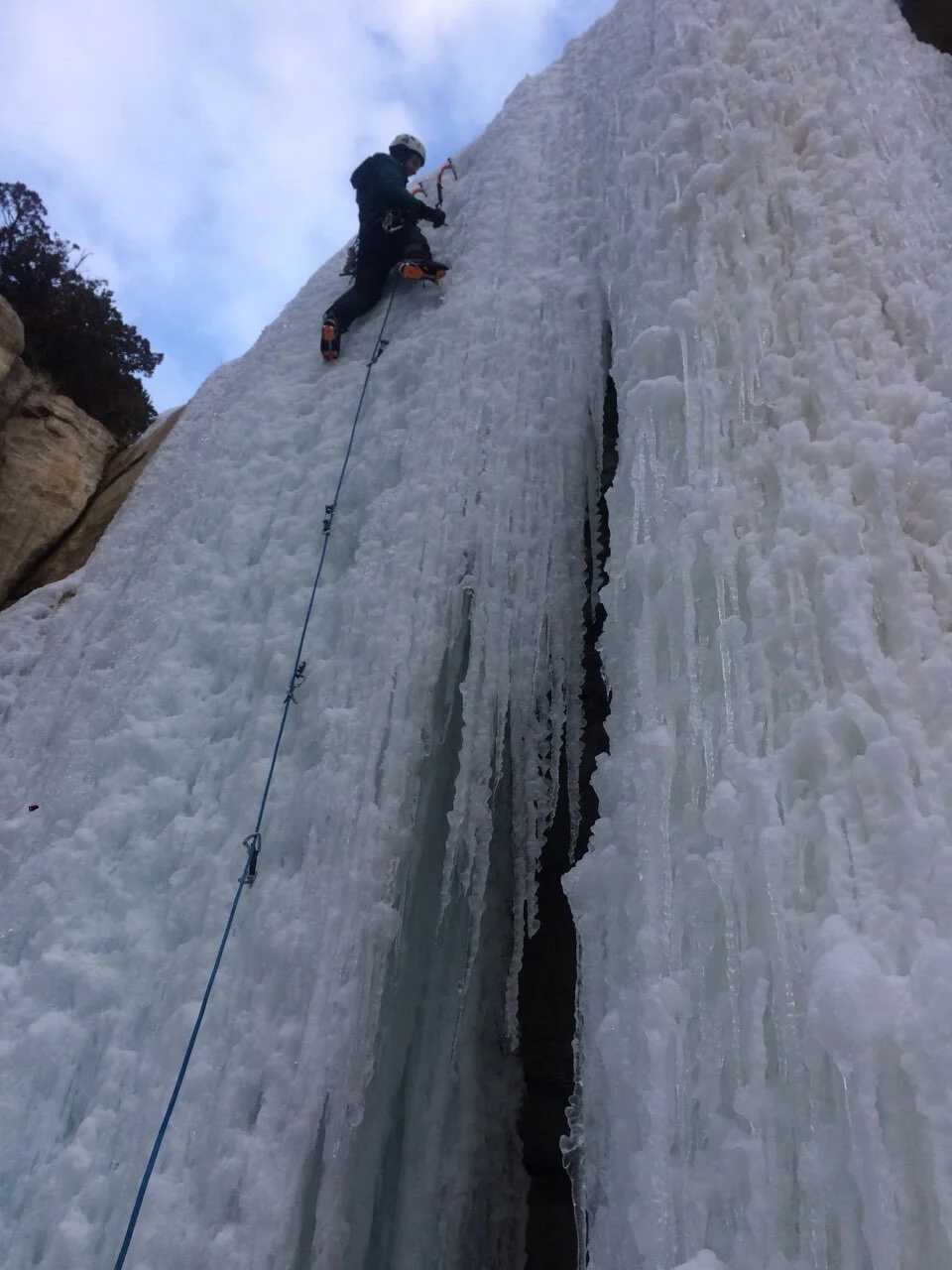
As I gained physical and mental strength, I was able to lead many pitches of ice. As this was my first lead, I was very eager to “sew it up” putting my protection very close together to stay safe.
Going All Out
But how strong is a well-placed screw? Well that all depends on the ice. Sometimes the ice is only a few inches thick, and you have to place a “stubby” which may not even go into the ice the length of your index finger. Other times, the ice forms giant cauliflower shaped bulges that are full of air bubbles and your ice screw won’t even bite in at all. Other times, heat has caused repetitive freeze/thaw cycles generating rotten ice that a screw may partially bite into but can easily be pulled out by hand. Many ice climbers carry quickdraws that contain shock absorption devices to reduce the force placed on the screw in the event of a fall. If they think that the ice is so delicate that it cannot handle much force, the shock absorber will be placed between the climber and the protection, and these are affectionately known as “screamers”. Could an ice screw hold a climber’s fall? Well…don’t fall.
Knowing all of this, my early approach to ice climbing was to place as many screws as possible while leading short pitches of ice. However, placing a screw is far more taxing than putting in rock protection and excessive placement can wreak havoc on your arms and legs to the point that you lack the strength to hang on. Ice screws become paradoxically an increased fall risk if you take too much time to place too many of them. It is beneficial to keep climbing through a steeper, more difficult terrain, and then place when you have a stable stance with less strain on your arms. However, it is difficult to convince yourself that this technique is a good idea when you look down several body lengths to see one lone screw between you and the ground as your forearms are burning and you desperately hang on. Placing early and often is ideal, but you have to save energy to finish the climb as well.
The other joyful discovery which I have only experienced a few times was the sensation of blood flowing into my fingers after a particularly difficult and cold lead. Since you are typically holding onto tools above your head, the blood pumping to your fingertips has a tendency of flowing down into your core. When it is freezing outside, the lack of bloodflow will slowly turn your fingers numb. They respond more slowly when you attempt to grip an ice tool or fumble with an ice screw. By the time you reach the top of your climb, they can often be frigid. This in and of itself is not so bad, until you lower your arms back down to your sides upon reaching the top. As the blood rushes back into your frozen fingertips, a rapidly increasing sense of sharp pain pulses into your throbbing fingers accompanied by a severe wave of nausea and an itchy sensation in your skin. Typically this lasts about a minute but is staggeringly painful tends to stop me dead in my tracks. This lovely sensation has been affectionately dubbed “the screaming barfies”.
I had learned a great deal after top roping over fifty pitches of ice, I began to slowly get more and more easy leads under my belt (sorry Will Gadd). The nice thing about ice climbing was that I always had the world’s best hold: a handle. This made climbing ice easier than cranking on overhanging small holds with a still weak arm. Ice rarely gets beyond vertical steepness and this provided an excellent way to strengthen my arms gradually. Each time I would work on my stance to make sure I had staggered foot and tool placements, and wide stances when possible. I found the strength and energy to swing lead multiple stacked pitches of ice falls in 2019. By 2020, I was able to climb 4-6 pitches of ice, leading each pitch myself and at what used to be my limit WI4+. Ultimately, I love climbing long multipitch ice climbs finding myself entering a flow state of supreme focus on the task at hand which requires not only execution of complex motor patterns, but also a silencing of the mind which eliminates fear, self-doubt, and hesitation out of necessity for survival. I do not know where ice climbing will take me next, but the climbing itself is a journey that means more to me than the target destination.